Technology Research Preparation Week 5
What research method have they employed, what issues were there
Applied research - industry standard
Creative, systematic work, research is about the creation of knowledge, for yourself, organisation or culture.
Opportunities to create new knowledge, searching for gaps in the existing knowledge.
Focused on single well defined problem.
you know what the problem is, and your research should be how do you find the solution
Research design vs Research method
Design: plan to answer your question
Method: strategy used to implement that plan
Good research design ensures data you obtain through executing your strategy
will help you effectively answer your research question.
Research Proposal
The approved research proposal defines what you can do. If something is not in the proposal then you can’t do it.
It should be to the industry-standard, almost can be submitted for review at industry.
Industry likes :
- Build on / improve existing processes, techniques and product quality
- New implies Risk, means longer approvals and lower funding priority.
- Gradual incremental steps with clearly stated cost/benefit goals (lower risk)
- Start with tightly scoped and focused pilot project, aim for 3 months. and use it to validate research in eyes of business decision makers (implementation)
- Maximise rewards, minimise costs with quick returns. Staff costs money, accurate time line with reasonable decision points (monthly)
Involve stakeholders asap, get their ideas, include them and acknowledge them - gets their buy-in, ownership, sponsorship.
Research Constraints
There are some unique constraints for research when dealing with Organisations. In my own experience I was effectively placed on staff for duration of the project:
- Cost: Interviewing an employee (manager, director, line worker) costs the organisation directly in salary (and overheads). It is an opportunity cost that may result in production delays. In developing your proposal you must work with stakeholders and gain “informal” approval.
- Time: Employees are subject to KPI’s (Key Performance Indicators) which they must meet. Your interview or work preparing your data could risk an employee not meeting a KPI. You must have senior level approval, so employees are directed/encouraged to participate in the research.
- Clients: Service Organisations will have confidentially agreements with their clients. You must discuss with management what, if any, constraints will be placed on your research. You may be asked (and I was) to sign a non-disclosure agreement. This will impact you if you hope to publish your research. I submitted all my articles for approval to senior management before publication. I also acknowledged and gave credit to the organisation’s role in my research.
- Competitive Advantage: Organisations are sensitive about knowledge associated with their real or perceived competitive advantage. This goes beyond a normal “non-disclosure agreement” and involves a high degree of trust usually only accorded to senior/line managers. Negotiation skills required! (You may need a sponsor)
Structure of Method & Design
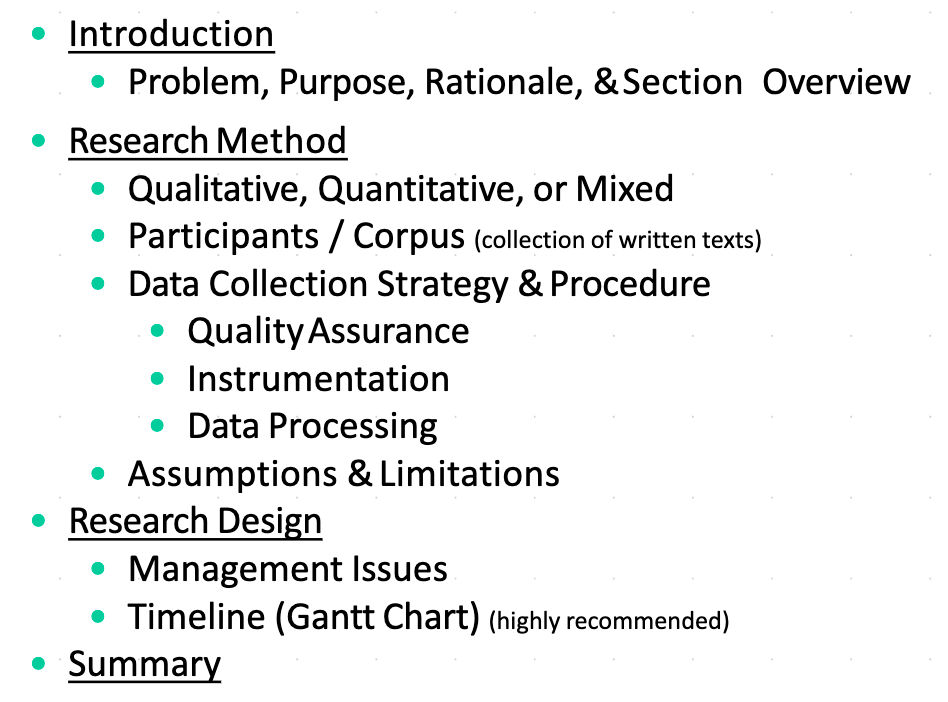
Limitations
Weaknesses related to decisions made in a research study
• They are difficult to contain
• Consequences associated with choices made in a study related to, for example:
• Sampling technique
• Data collection strategy (i.e. interviews, focus groups, …)
• Instrument used
• Population chosen (in terms of accessibility)
• Time and resources
• How would you be addressing expected challenges?
Assumptions
• Assumptions can not be totally controlled
• They need to exist for your study to be valid/ essential/credible
• Truthfulness/honesty of participants’ response
• Representativeness of sample
• Homogeneity of participants characteristics
• Having knowledge of your assumptions
• Justifying their existence
Delimitations
Features that can be controlled to determine parameters or scope Subject to Stakeholder Agreement, researchers have control over the following characteristics of the research:
- Research problem
- Research purpose
- Research question(s)
- Methodology
- Variables
- Population
Implementation of Research Method
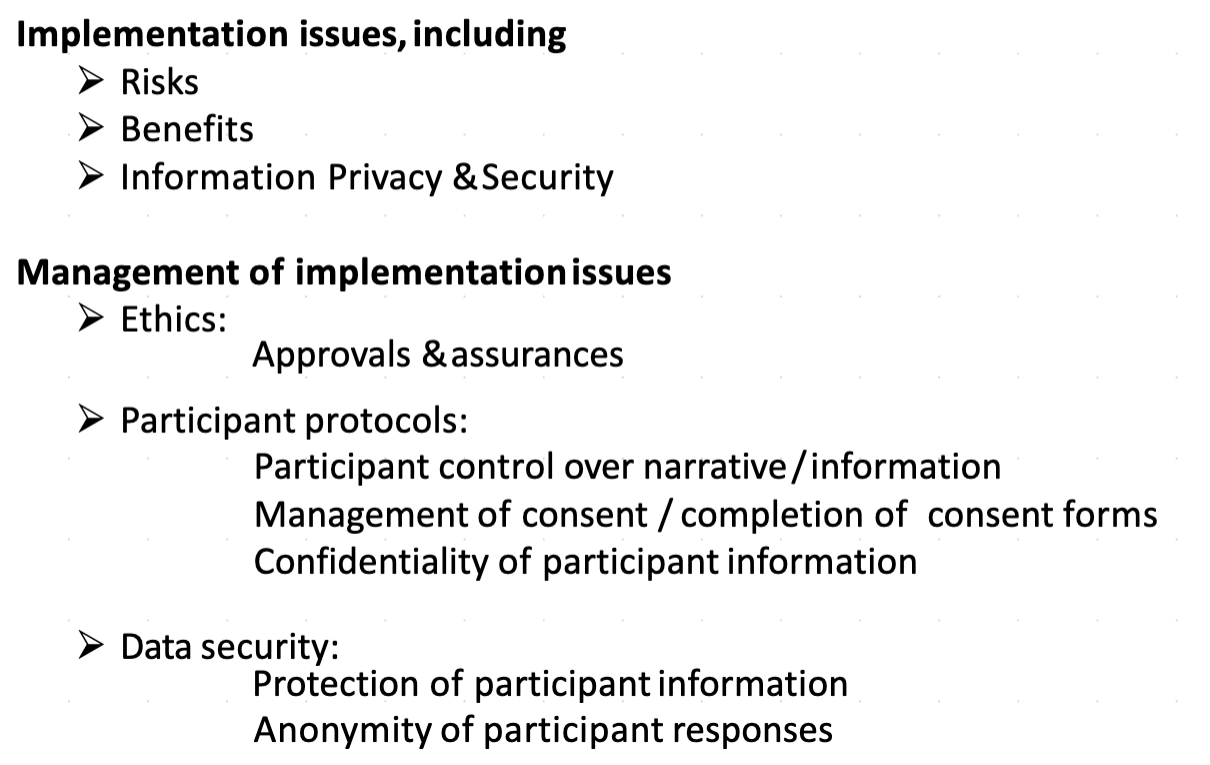
Qualitative Research
Qualitative research characterized by the collection and analysis of textual data:
- surveys,
- interviews,
- focus groups,
- conversational analysis,
- observation,
- ethnographiess
and by its emphasis on the context within which the study occur
Research questions:
- What is occurring?
- Why does something occur?
- How does one phenomenon affect another? Answering these questions generally requires rich, contextual descriptions of the data.
In qualitative research, the value of data decreases with time.
Quantitative Research
aims to
- Classify features,
- Count them and
- Construct statistical models in an attempt to explain what is observed.
Attributes:
- Researcher knows clearly in advance what he/she is looking for
- Recommended during latter phases of research projects
- All aspects of the study are carefully designed before data is collected
- Researcher uses tools, such as questionnaires or equipment, to collect numerical data
- Data is in the form of numbers and statistics
- Quantitative data is more efficient, able to test hypotheses, but may miss contextual detail
- Researcher tends to remain objectively separated from the subject matter
Mixed Methods Research
General Characteristics:
- Combines both quantitative and qualitative methods.
- Data can be collected simultaneously or sequentially; depending upon design.
- Allows researchers to expand an understanding from one method to another or converge or confirm findings.
- Researcher draws on breadth of generalization offered by quantitative research with depth of detailed understanding offered by qualitative research.
- Design may or may not be driven by a theoretical perspective.
Two data collection methods; one is embedded (i.e., nested) within the other:
- Priority is given to primary data collection approach with less emphasis placed on the nested approach.
- Data are mixed during the analysis phase.
- Primarily purpose: is for gaining a broader perspective than could be gained from using only the predominant data collection method.
- Secondary purpose: is use of embedded method to address different research questions or garner information from different groups or levels within an organization.
- Strengths: able to collect two types of data simultaneously; can collect both quantitative and qualitative data allowing for perspectives from each; provides advantages of both methods.
- Weaknesses: data needs to be transformed to allow integration during analysis, this may lead to issues in resolving discrepancies that occur between different data types; there is little literature in this area; results may be biased by differing priorities assigned to research design results.
Things to include
Decisions:
What decisions have you made ?
Actions:
What actions do you plan to take in the research study?
Rationale:
Why do you want to take those decisions and actions?
Implications:
What are the potential implications of your decisions and actions?
Implementation Process:
How do you plan to implement the decisions?