Fundamentals of Data Analytics (32130) Week 2
Data Analytics
in a business context, is the process of analysing raw data to find patterns, answer business questions and draw conclusions based on the info available in data. Data is collected in raw format and processed according to the requirements of an organisation to gain insights that enabled informed decisions to be made.
The increase in the size of data has raised demand for data analytics to find novel, commercially valuable and exploitable patterns.
The main aim of data analytics is to discover meaningful info ad knowledge from data, which can help to boost the performance of a business.
Businesses can improve productivity, increase sales, make customer service more efficient, and produce better marketing campaigns with the help of data analytics.
DA is transforming and will transform any part of business and society, from the way banks and shops operate to the way we treat cancer and stop the spread of pandemics.
No matter what job you are in and no matter what industry you work in, Big Data is shaping it.
Web mining
process of data mining techniques to automatically discover patterns and extract info from the WWW.
Retailer
use big data technologies to get closer to the consumer and to better understand consumer preferences and purchase patterns.
Telecommunication
load forecasting predicts the traffic of base station, OTT services, in order to realize intelligent and dynamic configuration of network traffic.
Market Analysis
assessment of the market both in volume and value, looks into customer segments and buying patterns, the competition and the economic environment in terms of barriers to entry and regulation.
Banking
using to get better actuarial assessments and offer more options. Loan providers now take into account many variable to determine customer financial responsibility and increase credit prediction correctness and reduce the ratio of bad debt.
Fraud detection
Historical data may be used to build models of fraudulent behaviour, and data mining can be used to help identify similar instances.
Data Analytics professionals
Data analysis can help companies to better understand their business context, be more reliable, and in framing a business question. The data analytics techniques allow the collection, understanding, and processing of data from across the business and possibly externally to deliver benefits.
Data Scientist
uses computer programming, statistics, maths, and ML to analyze how data impacts your organization as well as how it can be used to solve problems. They also use their skills to build models for predictive analysis and work on improving algo used by businesses.
Responsibilities:
collecting, cleaning datasets; determining which questions you should ask, writing code, analyzing results and creating reports that present findings.
Data Architect
Chief Data Officer, takes a high-level view of your org data and how to use if effectively. Role includes collecting, classifying, storing, organizing, managing and making accessible an org data. Also focuses on improving business processes through tech solutions such as digital platforms like cloud computing.
Responsibilities:
Determining when to implement new tech and systems, analyzing how current systems can be improved and implementing new ways for employees to collect data. Also create policies for handling sensitive info or protecting important infos from hackers.
BI developer
works with big data platforms to analyze raw data from an org’s internal or external sources
uses tools like SAS, Oracle, SQL server, and R to help companies develop strategies based on their data analysis. Create reports that a company’s executives can use to make informed decisions about running their business.
Responsibilities:
Collect data from various systems within an org and then transform it into meaningful info that can be analyzed. Results are then presented back to decision-makers, so they can use them to make better decisions regarding operational process etc.
Data Engineer
collect, store, analyze and report on, visualize various forms of data for business purposes. Bridge between developers, and data scientsits.
Responsibilities:
Task to collecting, storing, analzying huge volumes of structured and unstructured data.
Data analyst
Analyzes raw data to derive meaning and glean insights that can be used to improve business operaitons. Can help businesses interpret info, from customer behaviours to employment trends, using a business intelligence platform and data visualization tools to work with their company’s raw data.
Responsibilities:
Working with spreadsheets, analyzing large datasets using statistical software, writing reports and presenting.
Data Analysts are one of THE most sought after professionals in the world.
The role of the data analyst has become increasingly important during the internet age, with employment opportunities in industries ranging from financeLinks to an external site. to marketing to social media. In addition to knowing your way around computers, data analysts must also be well-versed in statistical methods and models. Big data and machine learning are among the cutting-edge applications of data analysis.
Decision scientist
Utilizes scientific methods, like data analytics, statistics and ML to solve business problems. Work with algos that help them analyze data quickly to determine which options produce optimal results.
Responsibilities:
Developing mathematical models, applying statistical analysis techniques, creating algos, identifying trends and patterns within datasets , building predictive models and interpreting results to make recommendations.
What those data analyst do
turn raw data into models that can be used to solve business problems.
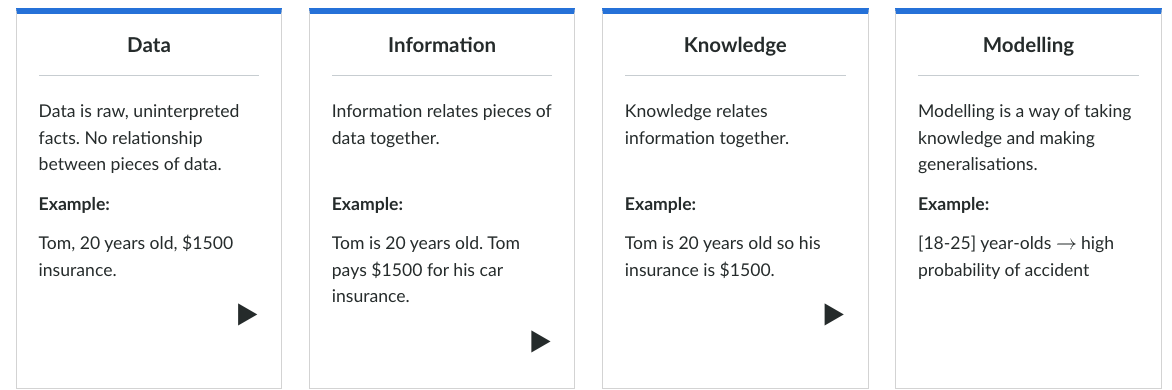
Data mining process
- Business Problem
We have to strongly frame a Business question - it could be “what are the different types of customer that we deal with?”. Question can be broad in this stage
- Data Mining Problem
We want to transform the Business Problem into a Data Analytics question by rephrasing and translating the terms to read more like an analysis task “Cluster the customer into different groups”. Cluster is used as its a DA technique.
- Data Mining
- Collect relevant data (internally or externally buying it from suppliers)
- Prepare the data
- Understand it, process it and put it together by building some models
can draw upon info, tools and techniques from many resources:
- data warehousing
- data information visualisation
- methods and frameworks
- knowledge discovery techniques
- Patterns
we identify patterns within the models, it might demonstrate useful patterns that answer the business question, so we will need to evaluate them,
If answered, done, but if not, we might need to tweak the question and run the processes again.
Data mining is an iterative process.
- Business Intelligence
Now we have the answer, deploy the model and results so business can act on it. May be in the form of presentation, a report or writing some software.
By explaining your findings, you add value to the data and improve knowledge for better decision-making.
Approaches in Data Analytics
Knowledge Discovery in Database (KDD)
Iterative process to produce appropriate knowledge, evaulation metrics can be developed, mining improved, new data integrated and transformed to produce different and more appropriate results.
Main goal: extract knowledge from a collection of data
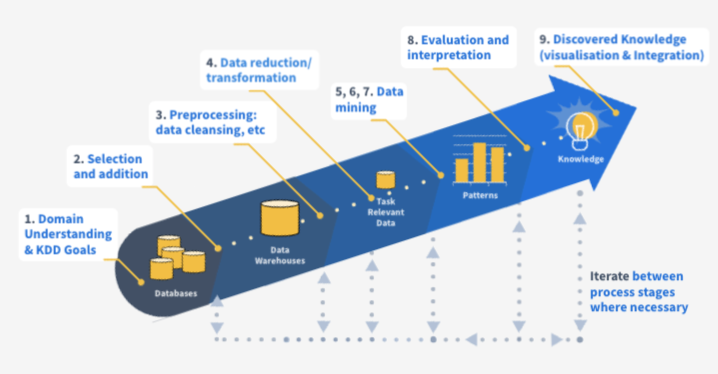
Iterate between process stages where necessary
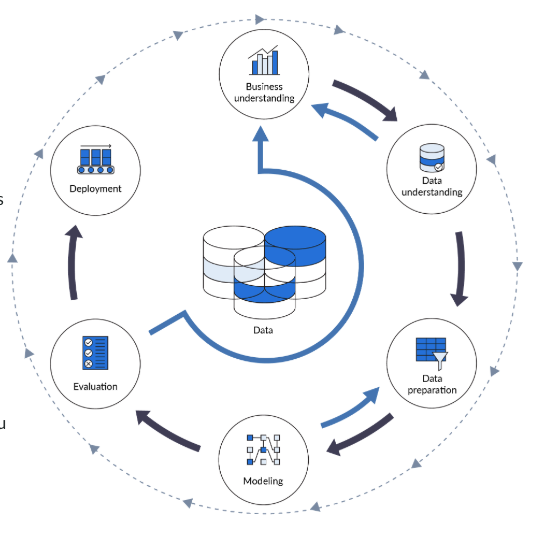
Cross-Industry Standard Process for Data Mining (CRISP-DM)
Base for a data science process, describes typical stages of a project in the context of business understanding, tasks related to each stage, and the relationships between these tasks.
helps to focus on building real business values
Statistical Approaches
Descriptive statistics
minimum, maximum, median and mean.
gives us summary statistics that can describe a whole group of data.
Predictive statistics
using statistics to make forecasts and inferences
Results
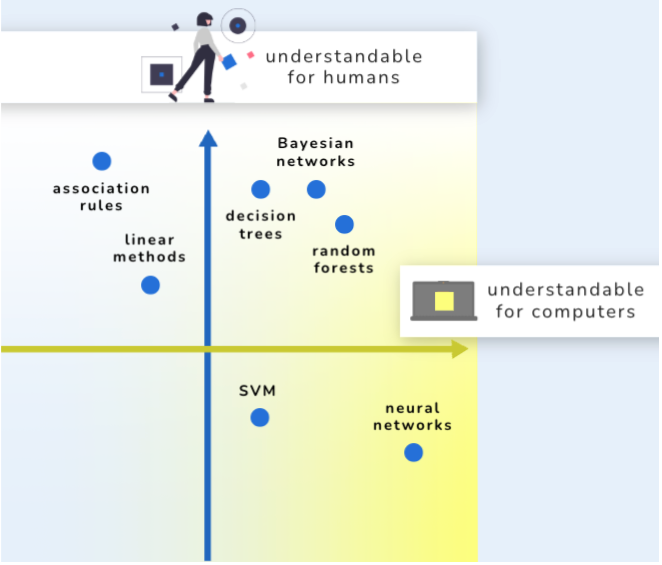
Data analytics result needs to be understandable by humans, easily read and accurate on computers.
Ethical Principles
Transparency, Fairness, accountability, privacy and community benefit.